Saturday, November 3, 2012

SPIDER MOVIE - PART IV: Spider-man (Cocky Little Wall-Crawler)


In regards to the origin and depiction of Peter Parker as a nerd, Sam Raimi may not have hit the mark 100%, but he wasn't that far off either.  Today I'm going to point out where the Raimi films really started to drop the ball.  "Where?" you ask.  "Perhaps the Villains?"  No, not for the most part.

I refuse to acknowledge that this ever happened.

"Perchance it was the relationships which you feel were so unjustly handled?" you ponder. Again, No- well... Yeah, but I'll get to that next time.  "Then What!? Where did the original Spidey films go so horribly awry?"  Sadly the answer lay in what is arguably one of the most important aspects of any story.  The title character, Spider-man. 

That's right, you heard me. They got Spider-man WRONG.

Okay Raimi fans, calm down and hear me out for a sec.  I'm not referring to the costume, or the fight sequences, or even the agile movements of the character.  Admittedly all of those are important, and if I'm being honest both franchises got all of those things right.  No, I'm talking about the CHARACTER of Spider-man; only one Spidey film got him completely right and none of them were directed by Sam Raimi.

[Side note: concerning the costume.  Some people complain that Andrew Garfield's Spidey costume was 'inaccurate' when really, with a couple of minor tweaks that don't matter, it was perfectly accurate.  Never once was I confused as to who Spider-man was, and once the film was underway I barely noticed the few 'changes' that were made.  I guess if you didn't like the costume that's up to you, but to say it was "completely inaccurate", as some have, is nothing less than an overstatement.  Period.]

Before I go into who did what right or wrong, I'm going to first clarify what it is about Spidey that is so distinctive aside from his tendencies to wear a specific costume and bounce off walls like an insect-monkey on a sugar high.  The element in question is an aspect of the character so important that it's probably why you liked him in the first place.  What is it?

*ahem*

Spider-man is a cocky asshole.

Don't get me wrong, he's a GREAT guy, and a much better human being than I am, but he's kind of an enormous asshole too.  He's constantly smack-talking his enemies, taunting them about their criminal inadequacies and bad fashion sense, and defeating them with well-timed wedgies.  He's a hero with the strength of a demi-god, zero shame, and wears a full body leotard that provides all the anonymity of a public internet forum.

Because, much like the internet, masks offer fool proof anonymity... as long as no one exposes you.

To be fair, telling Venom he needs a mint, or Doctor Octopus that his haircut sucks makes a lot of sense.  It may not be very magnanimous, but trying to distract or psyche out your adversary in the heat of a life or death battle may mean the difference between... well, life and death.  But it's not just the super villains and thugs who get the brunt of his smug posturing.  Everyone from police officers, rescued captives, and members of the press have felt the wrath of his searing wit.

"They deserved it!  He put his life on the line and the people still hate him for it!"

True.

True.

But then really think about it.  Why wouldn't they a little bit?  How many times has someone put on a fake Spidey suit and robbed a bank?  How much property damage has Spider-man been involved in?  Sure, the truth may be obvious to us, the reader, but in the real world even the most open-minded individual would be unwise not to have at least a few doubts.  You'd think Spidey would consider that.  And do you know what Superman would do in the same situation?  He would sadly shake his head at the silly humans and majestically fly away without argument, his super-dignity intact. 

"And then, when no one is looking, I poop on them from really high up.  Bastards."

What would Batman do?  Probably grumble and fade into the shadows because he doesn't have time to deal with this kind of bat-bullshit.  Spider-man?  He's not nearly so gracious.  He certainly doesn't resort to violence, which is good, but he's not above name-calling, and there have certainly been more than a few instances of someone getting their mouth webbed shut or having their bum glued to the seat because they were rude.   That response would probably be considered assault in most places.  Definitely not evil. Usually justified.  Kind of a dick.

And we fracking LOVE it!

We do!  Because we would TOTALLY do that if we could get away with it.  Hell, most of us would likely do much worse.  But boy does it feel good to see J. Jonah Jameson get hung up by his trousers for the better part of an hour.  ‘Cause he had it coming, and THAT'S how justice works.’  ...Well, not really.  But screw it.  Jameson is a bitch anyways.

And that is the specific combination, timid Peter and cocky Spidey, that holds him together as a character.  You can't have one without the other and still maintain the audiences sympathy/interest.  Remember what I said about Peter Parker before?  How Peter is the part of the character that makes us love Spider-man instead of hate him?  The reverse is also true.  If Peter was JUST a manifestation of his weaker self we would almost hate him MORE.  Even with his powers if Pete's persona doesn't properly transform along with his costume change he becomes ineffectual as a protagonist.

Allow me to explain.

We've already established that we initially feel bad for Peter because he's an orphan who gets beat up at school.  That starts us off with a lot of sympathy mileage for the character, but it only gets us so far because we (the audience) don't really like stories about victims.  We like underdogs.  We hate victims. 

Let's compare two random characters, Lana Lang (from the TV show Smallville) and Ellen Ripley (from the Alien franchise).

Lana Lang is a character that many people don't like (at least not beyond her physical appearance) because all she does is complain, and judge, and bitch and moan about her lot in life.  Lana Lang lost her parents in a brutal accident when she was young, which is a tragic thing that normally we would feel bad about. But we don't.  We don't because it always seems like life is just never good enough for her, and even when things are going well she continuously focuses on the tragedies in her life.

Clark warns her to stay away from a dude who is apparently dangerous?  Obviously Clark is just jealous. Clark saves her life? He must be keeping secrets.  She constantly blames other people or circumstances for her misery and then waits for other people or circumstances to fix it.  Life is always full of woe for her in spite of the fact that she has been lucky to survive more head injuries and attempted killings than anyone has a right to, and all thanks to the myriad beefy handsome men who love, adore, and worship her.  Yet somehow her life is tragic.

There there.

What makes it truly annoying is that we aren't supposed to hate her.  She is supposed to be a desirable character; a good guy.  All of the characters speak her praises because of how amazing she's supposed to be, but we, the audience, see the truth.  She's useless.  Her defining attribute is that she is helpless and needs saving, and that is very frustrating to watch.

Conversely we have Ellen Ripley, a woman who (within a DAY) has her Doctor try to kill her with a magazine, witnesses the brutal murders of her entire crew, and goes toe-to-toe with the savage phallic-headed monster that has been stalking her incessantly with the intent of space rape.  As if that isn't enough, her hyper-sleep survival comes at the cost of her sanity, relationship with her daughter (who died during Ellen's 57 year absence), and ultimately her life.  For all intents and purposes this woman SHOULD be considered a victim, but she's not.  She never once claims that her life is harder anyone else's (even though it is), she never expects special treatment or privileges (even though she should), has to live without men fawning all over her (which is weird because she's Sigourney Weaver), and even when things AREN'T going well, all she focuses on is the hope of something good (newt, life, saving others, survival, etc.).

Constantly we are SHOWN examples of how awful this woman's life is.  Death and misery follow her around until her own horrific death, and yet up to her final breath she NEVER gives up in spite of insurmountable odds, a complete lack of combat training, and emotional pain that neither you or I could ever understand.

Just a day in the life...

Back to Spider-man

Peter Parker, on his own, is a slightly less annoying Lana Lang.  We will initially feel bad for him, but only to a point.  Eventually, however, being an outcast wouldn't be enough to maintain our sympathy and we'd start to feel irritated with him for being so weak and gutless, which is a problem you don't want your protagonist to have.  Spider-man is the answer to that problem.  Spider-man turns Peter from a Lana into an Ellen. 

Now when kids are mean to Peter we admire him for not lashing out because we know he COULD turn them into paste if he wanted to (and we almost wouldn't blame him).  In the same vein of thinking we forgive and even applaud Spider-man's snarky mouth and attitude because we like seeing him get the final word in after all the crap he's had to put up with.  It's what we would do, and it makes him come off as funny instead of whiny.

The transition and contrast from down-on-his-luck-Pete to happy-go-lucky-Spidey is vital to remind us that Spider-man is Pete's answer to having a bad day.  If Peter gets teased by the jock at school and then has a grim and serious fight with Doc Ock he kind of comes across as an over serious crime fighter who forgot to dress up in something respectable.  If he goes into battle and starts teasing the Doc for "overcompensating 4 times more than other people" we feel more endeared to him because "Look, his life sucks but he just keeps making jokes!  I tell ya', that guy never gives up!"  That makes him likeable. That's what makes him an Underdog and, as I've said before, we love underdogs.

Except maybe this one.

So what's the problem?  The Problem is I've noticed a recent trend where people dismiss Spider-man as a bit of a wimp.  I've had a number of conversations dealing with "which Superhero is the most bestest superhero EVER" or other similar subjects.  Unsurprisingly many people choose Batman as their favorite; and I don't blame them.  I too am an avid Bat-Fan,  but my issue isn't that anyone would pick him as their favorite, but that, when asked to compare why he was better than Spider-man, they wrote the web head off as "a whiner who can't get a date, and mopes around about his dead uncle.  Boo Hoo!  Get over it already!"  Because apparently Batman's tenacity to punch every bad guy in the face with his vengeance boner has NOTHING to do with his inablity to move on from the death of his parents.

"My parents brutal murder? Of course I'm over it.  Why do you ask?"

Where did this reputation come from? Let's take a look at how the films approached the web-head, shall we?

SPIDER-MAN 1-3, DIRECTED BY SAM RAIMI (2002-2007)

Many things about the portrayal of Spider-man are right here, enough things that even to this day I still enjoy the film on a whole.  He is, of course, ever the hero, standing up for what is right at the cost of his own personal gain.  He is a true friend to those around him, and lives with the burden of his guilt and responsibility without complaint.  And of course things do go wrong for him all the time, but that is the burden of being a hero after all.  And what a burden it is.

So what's wrong? That sounds pretty dead on, right? Where do I get off complaining about that? That's exactly what happens to Spider-man in the comics all the time!

What went wrong is that THIS...

HAH! What a jokester.

...became the public's perception of Spider-man.

In the Raimi films we still rooted for our hero because he was fighting the good fight, but at the same time you just couldn't help but wish that he'd quit acting so freaking depressed all the time.  In the first film he did sort of have a couple quips and a general 'happy-go-lucky' feel to him, so it wasn't a bad start, but he became increasingly morose as the series carried into the sequels.  The result was a Spider-man who almost never cracked wise.  It was like he was so busy being responsible that he forgot to have fun doing it.

In the comics Spider-man doesn't just bear his pain like a martyr, he makes jokes about it.  Sure sometimes he has it rough, his costume gets a tear, he misses a date, and naturally it bums him out when that happens, but he also takes it in stride, because he's your friendly neighborhood Spider-man.  It's how he roles.

Spider-man doesn't have the same grim obsession that allows Batman to brood for half his screen time.  So, when you make Spider-man brood ANYWAY it makes him seem like a wimp.  It disrupts the balance between Peter and Spider-man causing him to act a bit more like a victim than a fighter.

They overplayed their hand with making Peter 'down on his luck' and had him spend most of the films sulking about his misfortune.  Spider-man is supposed to be the fun guy, not a brooding avenger.  Or sobbing defender, as the case may be.

GRADE

For the Portrayal of Spider-man in 'Spider-man 1-3' I give:  6.5 out of 10

And it only gets THAT a mark because of the first film.

Sure the costume and acrobatics were spot on.   As such the visual spectacle was often enough to distract us, but back flips do not a character make, and for all his physical bravado this character was largely without fun.  Some will argue that Raimi's films had plenty of funny moments, which is true, but Spider-man didn't, and that's my point.

So what about...?

THE AMAZING SPIDER-MAN, DIRECTED MARC WEBB (2012)

Peter/Spider-man was a smart ass.  He cracked jokes, made fun of car thieves, spoke flippantly to the Lizard and even the cops.  He was still the hero, doing what was right (or what he felt was right) at his own personal expense, but he had fun doing it.  He also made more mistakes this time around, often jumping headlong into situations without thinking things through first.  In short; he acted like an impetuous teenager or young adult, like Spider-man should.  And all of that made him fun.

GRADE

For the Portrayal of Spider-man in 'The Amazing Spider-man' I give:  10 out of 10

For the first time I felt like I was actually watching Spider-man, instead of a really good stunt man dressed up in a Spider-man costume.


WRAPPING THINGS UP

Thus far I've given all the reasons why the portrayal of the lead character is more competently handled in the reboot.  What I haven't touched on very much is the supporting characters, specifically that of the leading ladies.  My next post will touch on Peter's relationships with Mary Jane and Gwen Stacy in their respective films.  Come on back next time for:
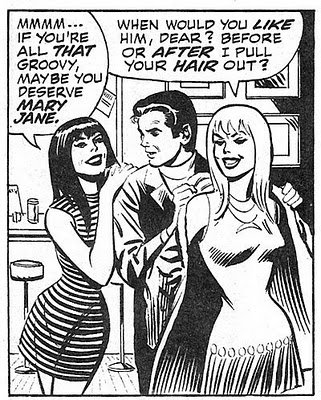

Is it just me or does Pete look kind of stoked about this?

See you then.


Thanks for reading

Monday, October 29, 2012

SPIDER-MOVIE - PART III: Peter Parker (The Nerd Factor)


It's not enough to have Spider-man just be all awesome, swinging through the city like a free runner, base jumper, and trapeze artist all rolled into one.  Yes, we love it when he does a back flip while simultaneously kicking Venom in the face, but as with all good heroes there must also be a struggle from WITHIN.  And stuff.  Thankfully not only is Spider-man NOT exempt from this rule, but his struggle from within makes his back flips seem like a cakewalk; enter Peter Parker.

Peter Parker isn't awesome.  He doesn't do incredible back flips, win fights, or get the girl.  In the game of life he does not pass go, and he NEVER collects $200. 


Not even when he's playing SPIDER-MAN monopoly.

It's not that Peter is stupid or lazy; he's quite the opposite on both accounts, and in fact is arguably a borderline genius.  The reason for his down-trodden status is that he's spent an entire life of estrangement from people in general, and as such has a hard time making connections and relating.  This social disconnection may be why his intelligence is so developed, but it's definitely why he's so lonely.   There's no doubt, the guy is just an honest-to-goodness-down-on-his-luck underdog.  And while this aspect of the character's personality may possess less piszaz than his crime-fighting alias provides, it's also one of the primary reasons we love him.

It's really a no-brainer.  People empathize with the underdog because everyone sees THEMSELVES as the underdog in the story of their own life.  Peter Parker is the poster boy for underdogs.  Not only is the guy protecting the innocent from adversaries that constantly outmatch his own abilities, but he's usually making a personal sacrifice to be there.  Whether he's missing a date, Aunt May is on her death bed, or he's just late getting his English essay in, he always shows up to fight the good fight, and usually without so much as a thank you.  Noble to the end.  He's everything we admire in a hero all wrapped up in wish fulfillment.

That last part is important.  Wish fulfillment.  Without that element Peter wouldn't be Peter.  After all, if Peter had been born with amazing spider-powers he'd have been off partying, joining the sports teams (all of them) and getting laid numerous times before even hitting puberty.  Life would be easy for him, and that would be no fun for us.  However, with a healthy injection of the 'wish fulfillment factor' the audience can now root for him. 

We don't cheer for people who were BORN with power, we cheer for those who FINALLY have power; those who have suffered and waited for an opportunity to turn the tables; those who will finally make things right.  It's why we love Harry Potter (even though he's constantly doing stupid things), root for Luke Skywalker (even though he's whiny), and it's even why many American's voted for Barrack Obama (even though he's... a politician)

"Ha ha.  Very funny asshole."

In order for Spider-man to work Peter must first spend his life as an outcast, a nerd, or else he's just a cocky jock with super powers.  He must first begin with nothing in order to have wishes that need fulfilling.

With "the nerd factor" being so critical to any film portrayal of Peter Parker, it begs the question;

WHO DOES IT BETTER?

First up...

SPIDER-MAN (2002) – Directed by Sam Raimi

Peter Parker (as played here by Tobey Maguire) is portrayed almost exactly as he is in the comic.  He's a science nerd with a big brain.  We know this to be true because we're told he gets good grades, and numerous times throughout the series are told that he's smart/brilliant.  If that's not enough to convince you of what a huge nerd Pete is you need only look at his appearance.  Look at him!  What a loser.  He wears dorky clothes, his glasses look big and dumb (doubtless from doing so much geeky homework), even his haircut looks like it gets it's milk money stolen from the other more popular haircuts.  Throw in that he's awkward around girls and gets pushed around just for being so lame and you have the most pitiful person on earth.

Yup. All you have to do is take a quick look to see that Peter Parker is the LEAST likely person to become a highly acrobatic crime fighter.  And after all, isn't that the point?  Peter is an unappealing nerd.  Right?  That's what makes his transformation into the coolest person on earth so appealing.  It also works perfectly into the wish fulfillment aspect of the story.  With such a spot-on filmic adaptation of the character, it almost seems pointless to ask...

WHAT DID IT CHANGE FROM THE COMIC?

...Actually, a bit more than you'd think.  To be fair, it's really more what Sam Raimi's film 'left out' as opposed to what it 'changed' per se, but the result is the same.

The first most noticeable change was the switch from Mechanical Web-shooters to Organic ones.  Initially this may seem less related to Peter Parker than it is to Spider-man, but you'd be wrong.  While the web-shooters may be used almost exclusively for Spidey's crime busting endeavors it was the CREATION of them that allowed for Peter's ability as a scientist and inventor to be realized.  Some would argue that by relegating Pete's webbing to an extension of his powers it downplays Peter's intelligence.

Think about how much more impressive his accomplishments are when you realize that he's whipping together batches of chemicals or even fairly sophisticated gadgets in his bedroom.  It's one thing for Batman or Iron Man to be genius Superheroes when they have billion dollar corporations to back them up, but when you can barely afford rent it becomes another matter entirely.

Pictured: An unfair advantage.

But then to be fair, I do understand the change to 'organics'.  After all it does seem strange to give someone 'all the powers of a spider', but to exclude the ability to make webs.  Even Stan Lee agreed with the change to organic web-shooters; and why, after all, should Peter's scientific prowess be limited to one device? 

In the comics it was often Pete's intelligence that helped save the day in the heat of battle.  Some villains need more than a punch to the jaw, and part of the fun was to see how Spidey would outsmart the villain.  And outsmart them he would.  Spider-man used his brains to assist him in his first battles with Dr. Octopus, The Lizard, and the Vulture, and that's just scratching the surface.  In the end I don't think the web shooters should HAVE to be necessary (even if preferable) as long as Peter gets to display the powers of his keen mind in some other way.

Seems fair right?

So on that note; quickly tell me one thing Peter Parker did in the entire Raimi Trilogy that displayed his massive intelligence, aside from being told he was smart, or getting into college. "That's easy" I hear you say, "right off the bat two examples from 'Spider-man 2' spring to mind."  And how right you are.  In Spider-man 2 we see Peter:

1.    Have an intellectual conversation with Doc Ock (prior to him becoming a villain).
2.    Do well in class during the montage immediately after he gives up being Spider-man.

Okay now mention one science based thing Peter Parker does to help him defeat ANY of his adversaries.  Just ONE time his scientific knowledge comes into play when he's fighting crime as Spider-man.   And the answer is... Nothing.  Zip. Nada. Don't believe me?  Allow me to list off all the ways Spider-man's enemies were defeated.

  1. Green Goblin: Stabbed (by his own remote controlled glider).
  2. Dr. Octopus: Convinced that being evil is bad, then sacrifices himself to save the city
  3. New Goblin (Harry Osborn): Gets beat up and decides to behave. Sacrifices himself to save Peter.
  4. Sandman: Gets blown up by Harry.  Even then, he still returns unharmed.  Ultimately Pete wins by getting him to apologize. But it's a really SINCERE apology.

"I'm not a bad person,  just had bad luck.  Like that unlucky time I 
was involved in your uncle's death, or when I kidnapped an innocent woman as
 bait to lure you into a trap so I could kill you.  THAT's how unlucky I am.  Sorry."

  1. Venom: Pete uses loud noises (sonics) to defeat Venom.  I would ALMOST count this as a 'science victory' except that Pete came upon it completely by accident.  He saw that the loud objects were causing venom pain and went with it.  Even I would have made the same connection, and I know almost NOTHING about science.

After dispensing the facts the only thing left is to pass my judgment.

GRADE
For the portrayal of Peter Parker I give Raimi's film: 7 out of 10

I'm not going to get down on Tobey for working with what he had, and it wouldn't be fair to say they got Pete COMPLETELY wrong.  Indeed, they got a number of things right.  At the very least Peter Parker was a dorky nerd outcast, just like in the Comic Book.

So what about...?

THE AMAZING SPIDER-MAN (2012) - Directed by Marc Webb

For the portrayal of Peter Parker in Webb's film it seemed a no brainer at the time to more or less stick with the comics.  Again if it ain't broke don't fix it right?  And yet looming overhead was the ever present threat of the prior series which was still fresh in our minds.  What could they do with the character that wouldn't feel recycled?

Then it happened.  The Trailer was released, and with it all our worst fears were seemingly realized.  Physically Andrew Garfield was a perfect fit (even most of the naysayer didn't have anything against the casting of the actual actor), but it was the presentation that people found off putting.  In terms of hair style, clothing, and physical demeanor this Peter appeared to be a fairly typical looking teenager (well movie teenager anyway) and that was no good at all because everyone, EVERYONE knows that Peter needs to be an uncompromising wimpy looking nerd.  HOW DARE YOU TAKE THAT AWAY FROM US!?

Truth be told, this is the only reason I buy tables in the first place.

With such blatant disregard for the source material it almost seems redundant to ask...

WHAT DID IT CHANGE FROM THE COMIC?

Well... some stuff, I guess, but it's a little tricky to put into point form.

It's important to remember that Spider-man was first introduced in 1962. Peter Parker was structured to be an anti-social misfit with a HUGE inferiority complex.  An outcast.  What better model to fit the bill of an awkward high-school outcast who constantly strikes out with the girls?  Clearly, a nerd.  A Geek.  A Bookworm.  In fact even during my childhood being a geek was a social death sentence.  But somewhere in the late 90's and early 2000's something happened.  Suddenly being a nerd stopped being a sign of weakness and started being this.

HAH!  What a nerd!  Everyone must HATE her!

The problem isn't that Peter Parker became obsolete, but rather the framework in which his character was built did.  To excel in Math, Sciences, English, History, or to display any extraordinary intelligence isn't enough to brand you outsider anymore; at least not on it's own merit.  For that matter, reading a Walking Dead comic doesn't ensure ridicule any more than going to the midnight screening of 'The Avengers', the latter of which makes you about as unique as... someone with tickets for a movie.  That's not to say that there aren't ANY socially awkward kids left in existence, because of course there are.  Indeed some of these individuals bury themselves in homework and comic books (or video games as the case may be).  But the difference is that being smart on its own is actually valued (as it should be), and comics, role playing games, video games, and science fiction have all simply joined television, films, sports, fashion, etc. in the grand world of pop culture.  Pop.  As in Popular.

Sticking with the traditional adaptation of the Peter Parker character becomes a problem because we can no longer accept his social alienation at face value.  Back in the day he was bookworm, which equaled LOSER.  Only the socially deficient and physically atrophied had time to devote their mental faculties to higher learning!  All the cool guys were too busy being cool, playing sports, driving cars, and dating girls.   Now, finally, add on that the comic series initially had a target audience of boys aged 6-10 (ish), an audience with whom simplicity is key.  In 50 years time the series' audience has (questionably) matured, and not only do we demand that our tortured protagonist have a legitimate roots to his problems, but that they're portrayed in a way that rings true to the year 2012.  Not 1962.

So back to 'The Amazing Spider-man'.  Have they changed Peter? 

Yes, and No.

-      Yes, in as much as that he now dresses like an average teenager (instead of a caricature of a dork).
-      Yes, in as much as that he isn't an especially weak teenager any more than he is especially strong.

Otherwise No.  The character isn't really changed at all.  The things that we've all been recognizing as 'changed' are all peripheral aspects of the character, completely dependant upon the era in which they're presented. The real threat this movie presented had nothing to do with Peter's updated fashion sense, but rather that they would try to give us some 'improved' explanation for Peter's ant-social behavior.  Thankfully the writers realized the work had already been done for them.

Peter had parents.  Now he's an orphan.  In fact not only is he an orphan but he was also old enough to remember who his parents were when they left.  Of course it was quite a while AFTER Spidey's first introduction before the comics touched on the subject, but that's to be expected.  The beauty of making a film based on a serial comics character is that you have the power of hindsight.  You can choose which story elements and characters to use, save for later, and discard completely.  Unfortunately Raimi's films decided to put the topic of Pete's parents in the "discard completely" pile, and that was the last of it.  THIS time around however the writers NEEDED to use it, and (perhaps inadvertently) tapped into one of the juiciest eggs in the Spidey mythology.

Many people will complain that the subject of his parents was left unresolved (I'll touch on that another time) but for the sole purpose of building the character it was handled brilliantly.  What better reason for an otherwise normal kid to be maladjusted?  No, he didn't have his parents taken from him by senseless violence (ala Batman), instead he was never given the closure of knowing WHY they were even taken from him in the first place.  What better reason to subconsciously avoid getting close to people, when all you've known is a world where the people who you love the most just disappear without so much as an explanation?

In this movie even Peter's intelligence (a trait he gets from his father) is fueled by a desire to make sense of the world he lives in, and the unanswered questions he so longs to have answered.  In this movie he's not unpopular, he's ignored (which is almost worse) because he's a loner, and people don't understand loners.  In this movie Gwen is plenty attracted to him (he's not ugly after all) but only AFTER he uncharacteristically does something which gets her attention.

In theory Peter, with or without powers, shouldn't have that much trouble succeeding.  He's a smart, good looking kid.  It's the psychological speed bump from a lifetime of uncertainty that causes Peter Parker to get in the way of himself, and having Super powers only exacerbates the situation.  He's thinks of others when he should be thinking of himself, and he becomes self centered when he should be focusing on loved ones.  He's a really good person, but he's also a screwed up screw up.  And that's the reason we love him so much; because no matter how badly he fails he will ALWAYS keep trying to make things right.

SCIENCE!
Speaking of Peter being a bright kid, remember my complaint from the Raimi films?  Well it was fixed here!  For starters the mechanical web-shooters were introduced, but that was small potatoes compared how his smarts are applied to the film's climax.

Pete uses his brain to beat the Lizard.  Yeah he fights him a bunch and uses his fists and stuff, so that was cool, but the proverbial nail in the lizards villainy-coffin was Peter's 'Reptile-be-gone' antidote.  No, it in no way mimicked anything remotely close to REAL science, but the point is that Pete's brain is the thing that saved the day.  For the first time I watched a Spider-man fight wherein Peter used his mind to win.

So, all that said, when people criticize the film for 'softening' up the character I can only shake my head in disagreement.  They cut away the fat and made him relevant to our era, and seeing as the film takes place in our era I have no problem with that.

BUT YOU FORGOT TO MENTION...
Still, some of you out there have lingering complaints which I've not yet addressed, so I'll proceed to do that now...

  1. "Peter Parker isn't timid enough pre-spider bite": This is the thing, Peter Parker was never THAT timid to begin with.  Truth be told, he always had a bit of a smart-ass mouth.  The only way he was EVER considered timid was in regards to his physical inadequacies.
  2. "Peter Parker didn't have enough trouble with the ladies in this film":  Pete actually never had that much trouble with the ladies where his personality was concerned.  Pete's 'list of ladies' includes Betty Brant (the cute brunette secretary), Gwen Stacy (a drop dead gorgeous blonde and Pete's first true Love), Mary Jane (a fiery redhead BABE), and along the way he was even able to garner the affections of Liz Allen (The hot blonde who was often dating Flash Thompson, the jock).  Those are just the main ones.  The girls liked Peter just fine, his problems had more to do with his alter ego more than anything else.  Keep in mind that by the time the man got to university he had dated more women than I have in my entire life (that's not a complaint on my part, but I'm just saying).  Sure, the man may have relationship problems, but finding the women to have relationship problems WITH usually comes down to choosing from the waiting list.
"Eenie Meenie Miney Moe..."

So then all that remains is to give my...

GRADE
For the portrayal of Peter Parker I give Webb's film: 10 out of 10

By shedding the character of any superficiality, and instead focusing on Peter's relationships and past, the writers were allowed to deliver much deeper insight to the psychological workings of the character.  That they were able to pull it off by actually USING the source material as a guide to offer us something 'new' makes it all the more satisfying.  Ultimately this is a Peter Parker I can relate to, and not just pity.

WRAPPING THINGS UP
Getting Peter Parker is very important, but there is one other aspect of the character that needs equal consideration.  Part of the appeal behind the character is in who he becomes once the mask goes on.  With that in mind I will be talking about how both films handled the portrayal of the webhead himself, in my next entry: 

"Spider-man: Cocky Little Wall-crawler"

Until then,
Thanks for reading.


-Fenske

Saturday, October 27, 2012

SPIDER-MOVIE - PART II: Origin Story (Adaptation vs. Interpretation)


As I stated in my last post, having a Superhero flick remain 'true' to the comics isn't always as imperative as we claim it to be.  Many elements of the comics have been altered in the films, and we usually don't even notice.  However, with even the most flexible of adaptations there are always certain parameters that must be, more or less, maintained.  The "unchangeables."  Of these 'non-exceptions' the most common comes in the form of 'the origin story.' 

For example: In Superman's origin story we insist that Krypton goes BOOM, and baby Kal-El escapes in a rocket destined for earth.  But really, no one cares if Krypton is an Ice Planet or an ultra cheesy shining utopia of intellectual perfection and atrocious fashion sense. There's plenty of wiggle room when it comes to the specifics, as long as the primary ingredients are maintained.

So too is this the case with Spider-man.  Who Peter's first girlfriend is, whether he's almost in College or just starting high school, is all irrelevant.   For the character to stay true to his comic counterpart the ESSENTIAL 'origin beats' that "MUST be maintained at all costs" are the following:

1.    Peter is an intelligent, teenaged, social outcast who struggles with life (in general) when...
2.    He is accidentally bitten by a Spider (that has been affected by whichever ‘science’ thing is currently topical) and, in turn, gains Spider based Super powers.

Science!

3.    Initially he is freaked out by this radical life change, but eventually comes to realize that having powers kicks ass.
4.    Over time he lets his new found abilities stroke his ego a bit more than is healthy and starts to act negatively, thus making poor choices.
5.    The last of these poor choices results in the escape of an armed robber who ultimately takes the life of Peter’s Uncle, Ben Parker.
6.    When Peter finds out that he is responsible for his uncle’s death (albeit indirectly), he turns his life around and starts to use his great power to help those in need.

Classic.  Everything you need in a good moral tale about heroism is right there, and now it's been filmed TWICE for your viewing pleasure.  This begs the question...

WHO DOES IT BETTER?

SPIDER-MAN (2002) – Directed by Sam Raimi

In respect to the origin story, Raimi’s film does get it pretty much spot on.   One could nitpick the odd thing here or there, but no one can deny that it’s a fairly accurate adaptation of the comic book.  Indeed, almost everything in the first 11 pages of Amazing Fantasy #15 have been brought to life in the first 30 minutes of "Spider-man", right up to the scene with Spidey chasing Uncle Ben's killer into an abandoned warehouse before making the heartbreaking discovery.

WHAT DID IT CHANGE FROM THE COMIC?

The film excluded Peter's mechanical web shooters (a subject I'll broach in my next post), as well as the fact that, in the comic, Spider-man actually had a major stint on live television before things went sour for him.  However, both of those are very minor plot points in the forming of our beloved character. 

GRADE

For the origin of Spider-man I give 'SPIDER-MAN': 9 out of 10

An accurate adaptation, both serviceable and classic.


THE AMAZING SPIDER-MAN (2012) - Directed by Marc Webb

I do not envy the position that Screenwriter James Vanderbilt must have been in when constructing the re-telling of Spider-man's origins a mere TEN YEARS after the original film (okay I might envy him a bit).   I won't beat around the bush; there are certain things that this film changed, which I suppose they had to, lest it feel stagnant with over-familiarity.   As such, I can't help but ask... "If Raimi's film had not existed would the changes that occurred in THIS film have taken place at all?"  Almost immediately I come to the conclusion that, no, they wouldn't have.  Still, the changes aren't necessarily bad.

I am a strong believer that restrictions breed creativity.  Obviously the writer couldn't all out change the origin, and yet he needed to find a way to make it interesting, to make us care. Again.  Which is easier said than done.  Simply making another Spider-man movie is one thing, but making another Spider-man movie about the SAME THING without causing the masses to yawn collectively is something else entirely.  For Raimi's film the challenge was much less severe than it was here.  We were so excited just to SEE Spider-man on the big screen that short of COMPLETELY screwing up we were going to love it no matter what.

It would be another two films before Raimi figured out how to convince us otherwise.

But with "The Amazing Spider-man" the writers had to come up with some new angle to present, and (surprisingly) as a result I actually found myself caring MORE than I did the first time around.  In "Spider-man" the origin focused on Peter Parker's journey into being Spider-man, whereas in "The Amazing Spider-man" it focused on Peter Parker's journey into being a man, during which he happened to get super powers.  I don't know if it was done on purpose, but we ended up getting an origin centered on CHARACTER dressed up as fun Superhero tale, instead of the other way around.  And I liked it.


WHAT DID IT CHANGE FROM THE COMIC?

Not as much as you might think, but a few things still.

1.    In this version Peter never goes into wrestling or showbiz at all.
2.    While Peter does learn that his uncle's killer is the same man he let escape, Pete never actually does find or catch the man in charge.
3.    The Spider bite still remains an accident although Peter was meddling in areas he shouldn't have been.  Traditionally Peter's accident is a 100% fluke and in no way his fault.  I'm not going to bring this point up again, because due to the way the film executed it I don't think it really matters.  It was still an accident.

And that's it.  That's all that was changed from the comics.  How does it affect the character?  Not really at all.  The end result of who the character is and what he becomes is the same.  The only reason why the 'Twilight Zone reveal' mattered in the comics is because it was a more dramatic ending to a story that wasn't guaranteed a follow up series.  The original comic didn't have time for a 'main villain' or even a particularly strong supporting cast (seriously, uncle Ben only has two lines, and we don't even SEE his death), so the most interesting dramatic device the story had going for it was 'the twist ending'.

Not unlike M. Night Shayamalan's movies.

But for the purpose of moving our hero forward into a larger and more involved plot (such as a feature film requires) simply letting Peter realize his critical error is enough.  In fact, having him NOT catch Ben's killer after discovering the truth only furthers Peter's lesson in responsibility because now he can't even take it out on anyone.  Peter is now forced to live with his mistakes and shoulder the burden of responsibility on his own.  For a character whose origin is rooted in responsibility this change makes a lot of sense.

"What about the lack of wrestling/showbiz in Spidey's early career?"

Again all you have to do is look at what the purpose that particular story element served in order to decide whether it was still necessary for "Amazing".  The showbiz angle from the comics was put in place to allow Peter's ego to grow out of control.  "The Amazing Spider-man" still had Peter become arrogant, as one would tend to do with newfound Powers, but by replacing the wrestling career with, instead, an added focus on Pete's relationships the writers were able to deliver the same effect without having to sacrifice screen time for it.  If this had been part television series there would have been more time to focus on the wrestling gig (serial shows allow for broader arcs).   However, with a feature film, if you can accomplish the same thing in less time, do it.

WITH GREAT POWER...

There is one other 'change' that bothered some people, which is not really a change at all.   Many will note that never once does uncle Ben state the famous catchphrase "With great power comes great Responsibility".  Fans were upset because this was Uncle Ben's big defining moment, and it was completely stripped from him!  What an appalling injustice!
This is worth destroying my property over!

But I would like to bring your attention to the fact that Uncle Ben never actually said that in the comic.  For those in disbelief, please observe the following

If you can look at that and NOT think dirty thoughts you
 are a much better person than I am.  Responsibility indeed.

Not a rousing speech in sight.  Uncle Ben only appears in three more panels after that, and doesn't speak in any of them.  In fact the familiar catchphrase, which we all associate with dear ol' Uncle Ben, doesn't appear at all until the very last panel at which point Stan Lee narrates:

"And a lean, silent figure slowly fades into the gathering darkness, aware at last that in this world, with great power there must also come-- great responsibility!"

Huh.  It's almost like Uncle Ben wasn't important at ALL beyond functioning as a stock character with a specific purpose within the confines of an incredibly brief throwaway story in the last issue of a dying comic series. 

It's almost like that because that's exactly what it is. 

Uncle Ben was only important to the development of the characters AFTER the fact in a very hindsight fashion.  Certain later comics and television series attributed the now famous line to Uncle Ben as an afterthought, but at the end of the day it wasn't really important who SAID it, but rather that Peter LEARNED it.

It should also be said that while "With Great Power Comes Great Responsibility" Is incredibly quotable, it doesn't really sound very good in every day conversation.  Does having Uncle Ben speak to Peter about Power and Responsibility make for a Great character moment? Yes.  Absolutely.  There's a reason that most modern updates including "The Amazing Spider-man" do it.  The only difference here is that the writers actually made it sound like something a father figure would say to his unruly surrogate teenage son on the fly, instead of it sounding like something he got from a hallmark card and set aside for future use "just in case".

HONOURABLE MENTIONS

Web shooters!  Peter's Parents!

This film they also included the mechanical web shooters, and introduced the back-story of Peter's parents.  The latter is a subject that was never touched on once in the prior Spidey trilogy (a brief mention simply alluded to their passing)

GRADE
For the Origin of Spider-man I give 'THE AMAZING SPIDER-MAN': 10 out of 10

A respectfully done interpretation of the character's origin.  While some minor changes were made in order to keep the story fresh, none of them altered the characters in any relevant way, and in some cases actually made for more compelling drama.


WRAPPING THINGS UP
Obviously this is just one of the necessary ingredients in a good Spider-man movie, and I understand that numerous other considerations need to be taken before I can simply chalk up "The Amazing Spider-man" as the superior film.  That's why next week I'll be comparing how both films dealt with what (I feel) is one of the most critical elements of the franchise, the depiction of Peter Parker.   Don't miss: "Peter Parker: The Nerd Factor"

Until then
Thanks for reading,

-Fenske